

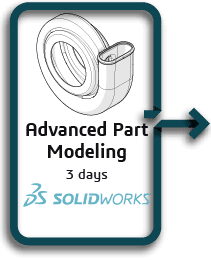
SOLIDWORKS Advanced Part Modeling
Advanced Part Modeling teaches you how to use multibody solids, sweeping and lofting features, and the more advanced shaping capabilities of SOLIDWORKS.
Advanced Part Modeling teaches you how to use multibody solids, sweeping and lofting features, and the more advanced shaping capabilities of SOLIDWORKS.
Topics covered are: sketching, multi-contour sketching, reference geometry creation, design intent, feature creation, shelling, configurations, assemblies, drawings/detailing, editing, parent-child relationships, relations, rudimentary top-down design, and advanced
mating techniques.
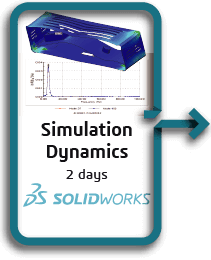
This course is designed for users who would like to become productive in analyzing structures subjected to various types of dynamic loading. The material covered includes the time-dependent analysis (force loads and motion shock loading examples), harmonic analysis and random vibration analysis (MILS-STD-810F example), response spectrum analysis, and introduction to nonlinear dynamics simulation.
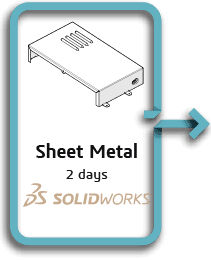
Sheet Metal teaches you how to build sheet metal parts using SOLIDWORKS mechanical design automation software. Building standalone sheet metal parts, and converting conventional parts to sheet metal, including in the assembly context, are covered.
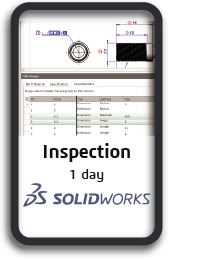
Learn the basics of working with SOLIDWORKS Inspection to automate the process of working with inspection documents. In this course, you will work with both the add-in and standalone versions of the product.

This course aims to teach you how to use DraftSight to optimize your drawings and designs for manufacturability so you can maximize quality,
avoid rework and decrease time to market.
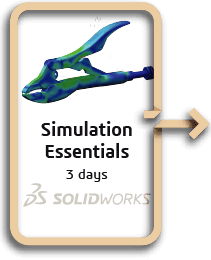
Topics covered in this course are: introduction to FEA; FEA principles and theory; element quality; linear static analysis of parts; gap/contact and advanced assembly analysis; analysis setup and post-processing; evaluating FE convergence; limitations of linear analysis; load and boundary condition application; stress analysis with thermal loading; model and result validation; automatic report generation.
Advanced Part Modeling teaches you how to use multibody solids, sweeping and lofting features, and the more advanced shaping capabilities of SOLIDWORKS.